Is drafting worth it in a marathon?
Running in a group can save you around two minutes over 42 km – more into a headwind, almost nothing with the wind behind you. Here is when it pays, where to run, and how the wind changes everything.
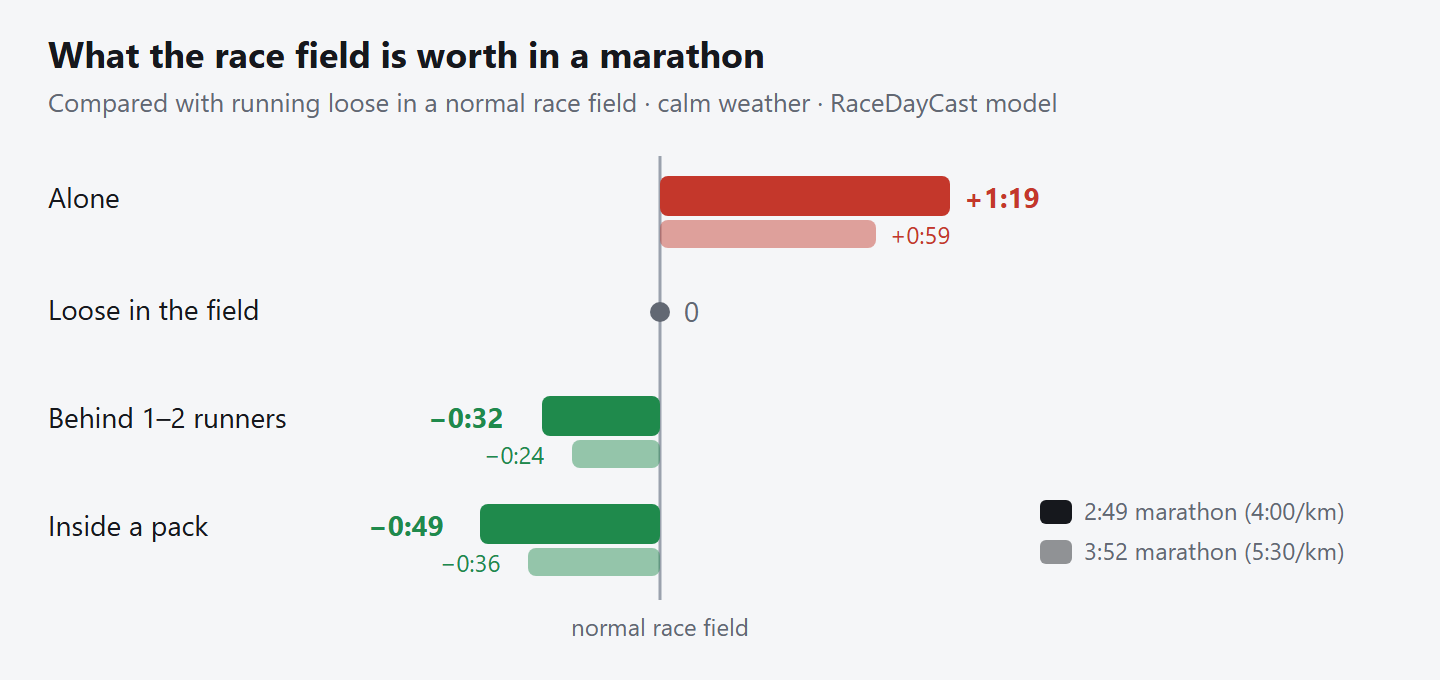
- Running alone costs you about 1–1½ minutes in a marathon compared with running in a normal race field.
- Sitting right behind someone or inside a pack saves another ½–1 minute. Alone vs. in a pack: about 2 minutes.
- The headwind is where it really counts. With the wind behind you, drafting gives almost nothing.
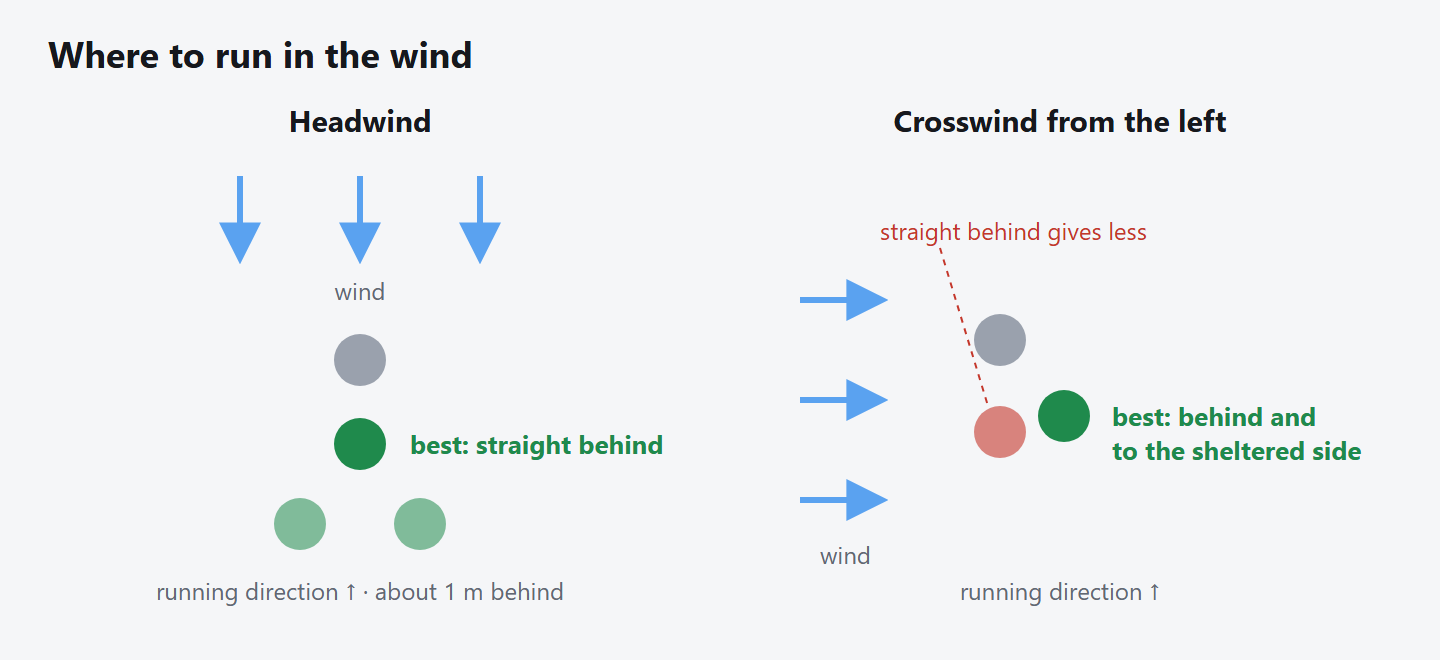
- In a crosswind, move to the sheltered side – behind and slightly downwind of the runner in front, not straight behind.
- Only draft at your own pace. A group that is 5 seconds per km too fast costs you more than any shelter gives back.
Why drafting works
Most of the energy you use when running goes into moving your body forward and up. But a part of it – a few per cent at marathon pace – goes into pushing the air out of the way. Behind another runner, the air is already moving with you, so you push less of it. The faster you run and the stronger the headwind, the bigger that air resistance is, and the more you save by tucking in.
When does it pay?
| Situation | Is drafting worth it? |
|---|---|
| Headwind | Yes – the most. Into a 4 m/s headwind, a pack can save you several seconds per km. |
| Crosswind | Yes, if you move to the sheltered side (see below). |
| Calm | A little – about ½–1 minute over a marathon. |
| Tailwind | Hardly. The wind is already pushing you; run your own line. |
| Open stretches – bridges, seafronts, wide roads | Yes. This is where the wind reaches you. Between tall buildings it matters much less. |
| A group running too fast for you | No. Going over your pace costs far more than the shelter gives. |
Where should you run?
A coach's view
Two minutes is a lot – it can be the difference between a new PB and just missing it. But the biggest gain is not the shelter itself: it is that a good group helps you hold an even, calm pace for the first 30 km. Use the group to save energy, not to run faster than you planned. And when the group drifts away from your pace late in the race, let it go and run your own race.
RaceDayCast shows the drafting effect kilometre by kilometre – alone, behind others or in a pack – with the race-day forecast.
Find your race →
Numbers from the RaceDayCast pace model (energy cost of running with air resistance and drafting, calibrated against published wind-tunnel and field studies). The values are averages for a typical runner; real groups are rarely ideal, so we use moderate shelter factors. Background: Pugh (1971, J Physiol) on air resistance and shelter in running, and Hoogkamer, Snyder & Arellano (2018, Sports Med) on cooperative drafting in the marathon.